

Why Pelvic Floor Pain Comes And Goes (And My Favorite At-Home Relief Strategies)
- Marnie Hansen
- May 22
- 6 min read


Pelvic floor pain coming and going? Looking for pelvic floor pain relief? Learn simple yoga, breathwork, and pelvic floor exercises to relieve pelvic pain, painful intercourse, and pelvic tension.
A common question I hear in my practice is:
"Why was I feeling better... and then suddenly worse again?"
A patient will come in after a few weeks of excellent progress. Maybe intercourse is less painful. Maybe sitting is easier. Maybe she's finally feeling hopeful about her progress.
But then... life happens...
A stressful work week transpired, or maybe she was on a long road trip. She had a hard workout, hike, or a poor night's sleep. A family crisis or stressful event happened. Maybe it was all of the above!
Whatever it is, she suddenly notices her pelvis start talking again. Loudly.
Cue anxiety. Maybe even panic. She thinks:
"Did I undo all my progress?"
(Usually, the answer is no).
In fact, temporary flare-ups are totally normal in the recovery process when going through a pelvic floor therapy program. As frustrating as they can be, flare-ups and setbacks don't mean you're going backward. They simply mean your body is responding to stress, postural loading patterns, hormones, movement, or nervous system input.
The key is learning how to calm things back down and being patient with your body, as it's giving you important cues to pay attention to!
In this article, I'm going to share some of my favorite yoga, breathing, and movement exercises that I frequently recommend to women dealing with:
Pelvic floor dysfunction
Painful intercourse
Vulvodynia
Pubic symphysis pain
Tailbone pain
Pelvic pressure
Pelvic tension
Hypertonic (overactive) pelvic floor muscles
First: Your Pelvic Floor Is Not Just Muscles
Most people think of the pelvic floor as a group of muscles. This is true in theory... it is, in part, muscle. But in actuality, the pelvic floor is so much more!
Your pelvic floor is also intimately connected to:
Your diaphragm
Your nervous system
Your hips
Your low back
Your breathing
Your stress response and emotions
Fascia throughout your entire body
When life gets overwhelming or busy, many women unknowingly hold and store tension in their jaw, shoulders, stomach, and pelvic floor. I see it every day in practice.
You wanna know the good news?
Your body can learn new movement patterns, and ways of processing stress (neuroplasticity is a beautiful thing... more on that in later articles).
Exercise #1: Diaphragmatic Breathing
This is my starting point for almost every pelvic floor patient.
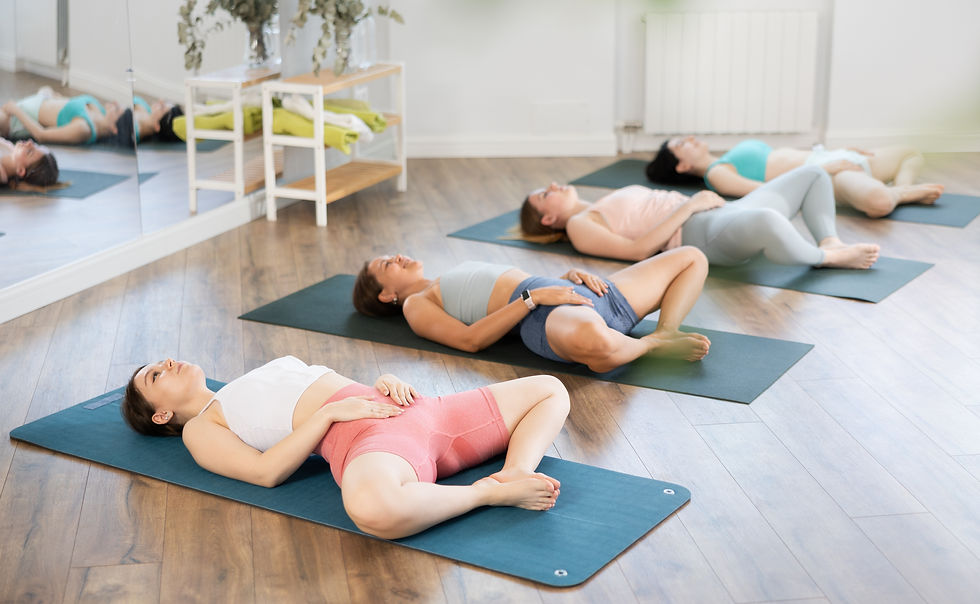
Lie comfortably on your back with your knees bent.
Place one hand on your belly and one on your ribs.
Slowly inhale through your nose.
Allow your belly and rib cage to expand (in every direction... let it all hang out!)
As you inhale, try to visualize your pelvic floor gently softening, relaxing, stretching and widening like a stretchy hammock (I like to think of Gumby, or a balloon expanding... visuals help).
Exhale slowly through pursed lips (this gently contracts the pelvic floor upward, which is what we want).
No squeezing or forcing. Or worrying about "doing it right."
Just breathe.
In cycles, choose your count... I like to do 5-6 counts in, equal counts out. Depending on your lung capacity, you may choose more or less... that is up to you!
Start with 3–5 minutes at a time. I like to do my breathing in the morning; others like to do it at night.
Many women notice their pelvic pain decreases simply by learning how to stop bracing all day long.
Exercise #2: Supported Butterfly Stretch
This gentle hip opener helps reduce tension through the inner thighs and pelvic floor.
Sit comfortably.
Bring the soles of your feet together.
Allow your knees to fall outward.
Support your legs or knees with pillows if needed.
Now combine it with your breathing practice.
Inhale and imagine the pelvic floor melting downward.
Exhale and simply relax.
Stay for 1–3 minutes.
No aggressive stretching required; this stretch is to be enjoyed!

Exercise #3: Happy Baby Pose
This yoga classic is one of my favorites for my own pelvic floor relaxation.
Simply lie on your back.
Bring your knees toward your armpits.
Hold behind the thighs, ankles, or feet.
Gently rock side to side, allowing your body to relax into the stretch.
Breathe slowly, no forcing necessary.
This position can help relax:
Pelvic floor muscles
Hip rotators
Low back tension
Tight adductors
And let's be honest... it feels good.
Exercise #4: Pelvic Tilts
Pelvic tilts are wonderful because they create movement without excessive strain. In my humble opinion, they are pivotal to pelvic floor recovery and long-term mobility.
And they are so simple, too!
Lie on your back (or sit, with equal weight on each sit bone).
On an out-breath, gently flatten your lower back into the floor (or tuck the hips under as you sit, bringing your belly button gently to your spine).
Then release all tension in the pelvis.
On an in-breath, create a gentle arch with your back as you lift the belly button to the ceiling (or if you are sitting, just let it hang free and "drop to the floor.")
Move slowly and comfortably. Think mobility, not intensity or forcing.
The pelvis loves gentle movement, especially when it's irritated. In my office, I call this the "great joint lubricator" as it "lotions up" the joints.
Because, you know... motion is lotion.

Exercise #5: Cat-Cow
One of the simplest and most effective spinal mobility exercises around. It is very similar to the pelvic tilts and moves that pelvis, too! Many times, women are able to connect more deeply with their breathing and sense of embodiment in their pelvic floors in this position, especially if the pelvic tilts are difficult at first.
Move slowly between:
Cat:
Gently round the back up as you breathe out, tucking the hips under, bringing that belly button to your spine.
Cow:
Gentle arching down (belly button to floor) as you breathe in and fill that belly up with fresh oxygen.
By coordinating your movement with your breathing, you create a dynamic flow in your core and pelvis. The goal isn't stretching as much as it is attaining fluid movement, marrying your breath to the movement. As pain often creates guarding,
movement helps remind the nervous system that the body is safe.

Exercise #6: Child's Pose (If Comfortable)
Not everyone with pelvic pain tolerates this position initially, and that is okay. Just modify it by using pillows or widening your knees. It is intended to be a comfortable resting pose, so hang out only where you feel comfortable.
If you breathe deeply into the belly, back, and pelvic floor, you might even feel a nice stretch or expansion of the muscles.
.
If you want to challenge this stretch a bit, just raise your tush into a puppy pose, and feel those pelvic muscles stretch as you widen your legs.
Any form of this stretch can be incredibly calming for both the body and nervous system.
Exercise #7: Gentle Walking
Sometimes the best exercise isn't yoga at all! It's walking.
Walking improves:
Circulation
Lymphatic drainage
Joint mobility
Stress management
Nervous system regulation
One of my favorite in-office instructions is: Don't exercise harder, just move more gently, and more often. Especially during a flare.
What To Do During a Pelvic Pain Flare-Up
When symptoms spike:
✓ Slow down
✓ Breathe
✓ Take a warm bath
✓ Use gentle stretching
✓ Go for a walk
✓ Prioritize sleep
✓ Stay hydrated
✓ Reduce unnecessary stressors where possible
Avoid the temptation to aggressively stretch, strengthen, or "fix" the problem in a single day. Your pelvis isn't broken; it's just asking for support.
A Final Thought
One of the most important tips I give my patients is that healing rarely happens in a straight line. There will be the good days, and there will be the bad days. There will be frustrating days and even moments where you might wonder if you are making any progress at all.
Then, one day, you will suddenly realize that you have been sitting longer, sleeping better, or walking farther without pain or discomfort. You might even notice that you are enjoying intimacy again.
Notice and celebrate that, as those small victories add up to a big win.
If you're struggling with pelvic pain, painful intercourse, pubic symphysis pain, or pelvic floor dysfunction, know that you're not alone, and that you don't have to figure it out by yourself.
Sometimes the first step really isn't really pushing harder, it's learning how to breathe, and move with the signals that precious pelvis is sending you :)
Looking for Pelvic Floor Therapy in Salt Lake City? Experiencing Pelvic Floor Pain?
At Salt Lake Spine & Pelvis, I combine pelvic floor therapy, chiropractic care, movement rehabilitation, soft tissue work, breathwork, and nervous system-focused care to help women move better, feel stronger, and reconnect with their bodies.
Want guided instruction? Join our Pelvic Floor Yoga & Mobility Class held every third Thursday at Salt Lake Spine & Pelvis. Details coming soon!


Comments